What Happens When a Passenger Becomes Critically Ill at Sea
Most people boarding a cruise ship never think about a medical emergency.

Cardiovascular events are a leading cause of medical evacuation, while respiratory complaints are among the most common medical presentations onboard cruise ships.
Modern cruise ships carry thousands of passengers, with some carrying as many as 7,000. Many are over 60 and have existing medical conditions.
While medical emergencies or medical evacuations are relatively uncommon, they do happen, and when they do, the nearest hospital could be hundreds of nautical miles away.
For the cruise ship onboard medical team, every minute matters and passenger safety is a priority. The challenge is not simply treating the patient but deciding whether they can safely remain on board or require a costly diversion or an emergency evacuation.
Technology is now changing how those decisions are made, and this is where remote patient monitoring on a cruise ship comes in. Imagine onboard healthcare technology that is accurate, up-to-date and comfortable for the patient.
The Challenge of Treating Patients at Sea
Unlike hospitals, cruise ships operate with limited staff and limited resources.
Typically, there is a single cruise ship physician supported by one or two nurses responsible for thousands of passengers and crew. When a patient deteriorates unexpectedly, clinicians often have only intermittent vital signs to guide critical decisions.
The medical team generally has three options:
Continue treatment onboard
Divert the vessel to the nearest suitable port
Arrange an emergency medical evacuation
Each decision carries clinical, operational and financial consequences.
Why Intermittent Vital Signs Are No Longer Enough
Traditional patient monitoring relies on periodic observations.
Blood pressure may only be recorded every 15 to 60 minutes.
An ECG may only be performed once.
Between those measurements, a patient's condition can change dramatically.
That leaves clinicians making critical decisions based on isolated, intermittent information rather than continuous information.
STAY. DIVERT. EVACUATE.
The quality of the decision depends on the quality of the information available.
Introducing VitalStream: A New Generation of Continuous Patient Monitoring
VitalStream changes that model completely.
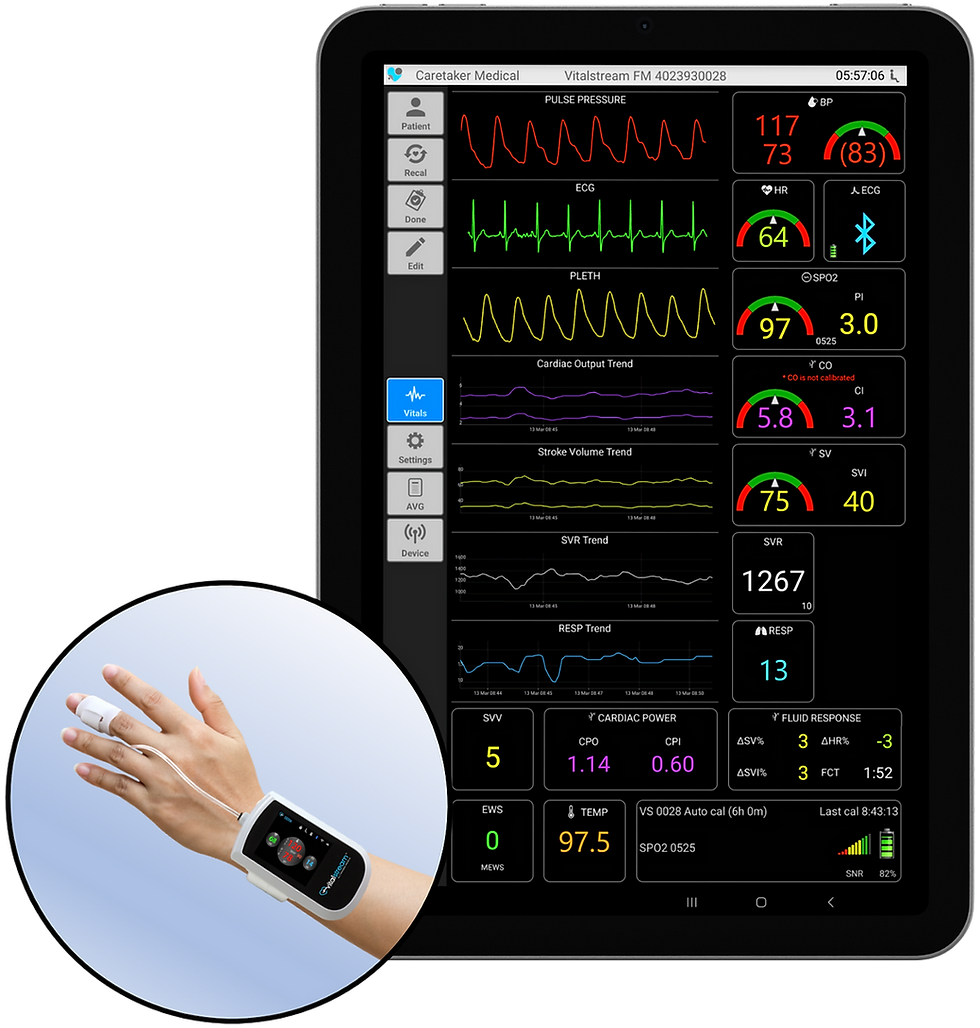
Instead of collecting occasional readings, VitalStream provides continuous beat-by-beat haemodynamic monitoring via a wearable, non-invasive device in real time.
Medical teams receive over 20 haemodynamic parameters in real time, including:
Continuous blood pressure
Cardiac output
Stroke volume
12-lead ECG
Systemic vascular resistance
Continuous temperature
This provides an evolving picture of the patient's condition rather than isolated measurements.
Better Decisions Mean Better Outcomes
When a cruise ship diverts, the impact extends beyond that one patient:
Fuel costs increase
Thousands of passengers may miss the next port
Passengers experience changes in their itineraries resulting in a poor guest experience
Crew schedules change
Company reputation
Insurance and legal documentation
Continuous monitoring cannot prevent every diversion. However, it helps ensure that diversions are based on better clinical evidence rather than uncertainty.
Supporting Telemedicine at Sea
Modern cruise operators increasingly rely on shore-based specialists.
With continuous live data, both onboard clinicians and remote consultants can view the same patient information simultaneously, allowing faster, more informed discussions around treatment, diversion or evacuation.
The Future of Cruise Healthcare
As cruises become larger, itineraries become longer, and passenger demographics continue to evolve, the need for continuous patient monitoring will only increase.
By providing the onboard medical team with real-time physiological insight, VitalStream helps transform critical decisions from educated judgement into evidence-based care. This supports better outcomes for patients, medical teams and cruise operators alike, while helping to maintain high standards of care at sea.
Discover how VitalStream can support continuous patient monitoring and clinical decision-making at sea. Click the link below to explore VitalStream.
4


Comments